HIGHFIELD LEVEL 3 INTERNATIONAL AWARD IN EMERGENCY FIRST AID AT WORK AND USE OF AN AED (DCAS)

This qualification has been developed for those who wish to become an Emergency First Aider and use a defibrillator. Learners gaining this qualification will know basic emergency first-aid procedures and will be able to use a defibrillator correctly.

Objective

The Leaners will be able to: (Theory Session)

1. Know basic emergency first aid requirements

  1.1 Describe the principles that underpin basic emergency first aid support

  1.2 Explain the circumstances under which resuscitation is performed

  1.3 Explain why early intervention is necessary

  1.4 Describe different types of cardiopulmonary arrest

  1.5 Demonstrate the DRABC emergency response

  1.6 Demonstrate the top-to-toe survey of an injury

  1.7 Demonstrate how to place a casualty in the recovery position

  1.8 Identify the risks when placing a casualty in the recovery position

  1.9 Conduct major bleed control on a casualty who has suffered bleeding

  1.10 Manage hypovolemic shock treatment for a casualty

Practical Session

1. Be able to demonstrate basic emergency first aid techniques in line with current

guidelines

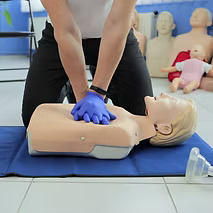
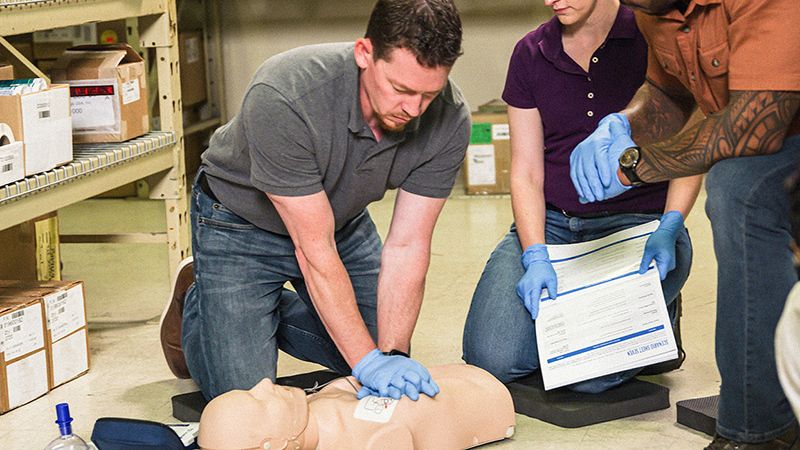
  1.1 Demonstrate cardiopulmonary resuscitation (CPR)

  1.2 Demonstrate compression only resuscitation

  1.3 Demonstrate the use of resuscitation barrier devices

  1.4 Demonstrate how to manage a choking casualty

2. Know how to safely use an automated external defibrillator

  2.1 Describe the differences between using an AED on an adult and child

  2.2 Identify safety considerations when using an automated external defibrillator

  2.3 Demonstrate the correct placement of AED electrode pads on a manikin

  2.4 Follow AED voice prompts accurately.

  2.5 Demonstrate how to combine the use of an automated external defibrillator with

        minimal interruptions in cardiopulmonary resuscitation using a manikin

  2.6 Demonstrate the safe delivery of AED shock

  2.7 State the procedures if the casualty shows signs of life and starts to breath normally

  2.8 Identify the information required when handing over the casualty

Assessment

The qualification is assessed using the Highfield assessment pack and is split into two component parts.

  • Practical Observation
  • Centre-marked multiple-choice theory assessment

Learners must achieve a pass in each element of the theory and practical assessments in order to pass the
qualification.

Pre-requisite

Learners to meet the necessary standards of the language in which the course is being delivered.

Certification & Approvals

HIGHFIELD INTERNATIONAL – UK

Validity

Upon completion, this qualification certificate is valid for a period of 3 years.

Course Duration

5-6 Hours ( Full Day )

Maximum Number of Delegates

12 Delegates

Venue

Client Premises (or) Belhasa Safety Training Academy – Al Quoz (4), Dubai – UAE

Health

All delegates will be asked to complete a standard medical questionnaire prior to course commencement.

Dates and Cost

Available on request.

Documents Required for Registration

•   Emirates ID copy

•   Company Trade License

•   VAT Certificate ( If Applicable)

Note

1. Candidates must bring their original Emirates ID when attending training.

2. Candidates who wish to register as individuals are only required to submit a copy of their Emirates ID.

RATE / FEES:

For further information regarding our rates or fees, please feel free to contact us using the
details below:

Contact Numbers:

04-3244896 / 052-1074285

Email Addresses:

info@bamtc.com /lal.krishna@saifbelhasagroup.com

Overview:

1. Practical Observation –

This component involves the direct observation of learners as they carry out specific tasks or activities in a practical setting. Assessors evaluate performance against clearly defined criteria to ensure learners can demonstrate the required skills, competence, and application of knowledge in real or simulated work environments.

2. Centre-Marked Multiple-Choice Theory Assessment –

This written assessment tests the learner’s understanding of key concepts, principles, and knowledge areas relevant to the qualification. Learners answer multiple-choice questions, and the assessment is marked by the approved training center following HSI Medic First Aid’s marking guidance.

To successfully complete the qualification, learners must achieve a pass in both the practical observation and the theory assessment. Failure to pass either component will result in an overall non-achievement of the qualification, ensuring that successful candidates demonstrate both practical competence and theoretical understanding.


• Emirates ID copy
• Photo
• Completed Registration Form